Francisco Aranda Espinosa
Biografía
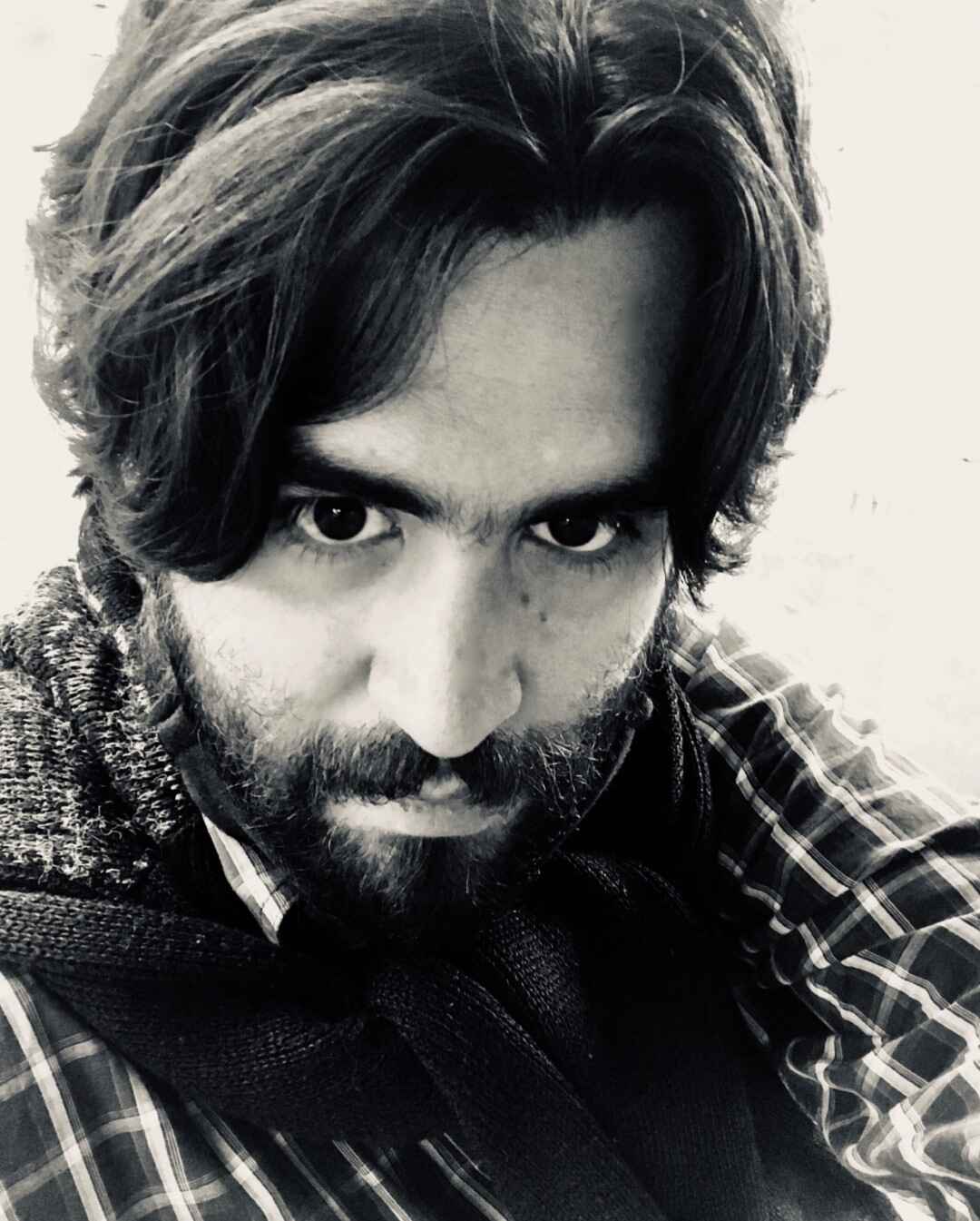
Francisco Aranda Espinosa es pianista y profesor investigador. Licenciado en Música, Maestro en Investigaciones Humanísticas y Educativas y Doctor en Filosofía e Historia de las Ideas, es miembro del Sistema Nacional de Investigadores (SNI-SECIHTI).
Se desempeñó en la Universidad Autónoma de Zacatecas de 2017 a 2023 y actualmente es Profesor Investigador de Tiempo Completo en el Instituto de Artes de la Universidad Autónoma del Estado de Hidalgo (México).
Cuenta con más de 30 publicaciones —libros, artículos, capítulos y textos de divulgación— en revistas y editoriales de calidad internacional, en español, inglés y francés. Su trabajo articula la investigación en filosofía de la música, estética y arte desde una perspectiva inter y transdisciplinaria. Desde 2025 incursiona también en la poesía y la literatura, con publicaciones en revistas de alto prestigio nacional e internacional.
The Last Supper of the Compliant:
Obedience and Etiquette at the Apocalypse in ‘Silent Night’
Francisco Aranda Espinosa

Image 1: Screenshot from ‘Silent Night’ (2021), cinematography by Sam Renton.
(*) All subsequent images are likewise screenshots from ‘Silent Night’ (Griffin, 2021).
A Polite Dinner at the Edge of Extinction
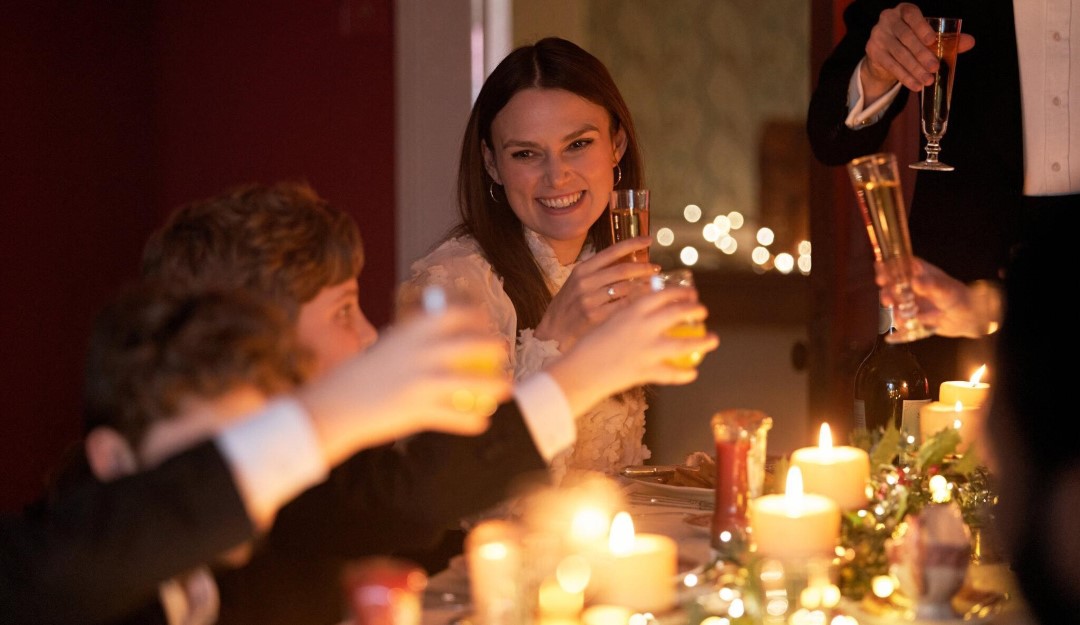
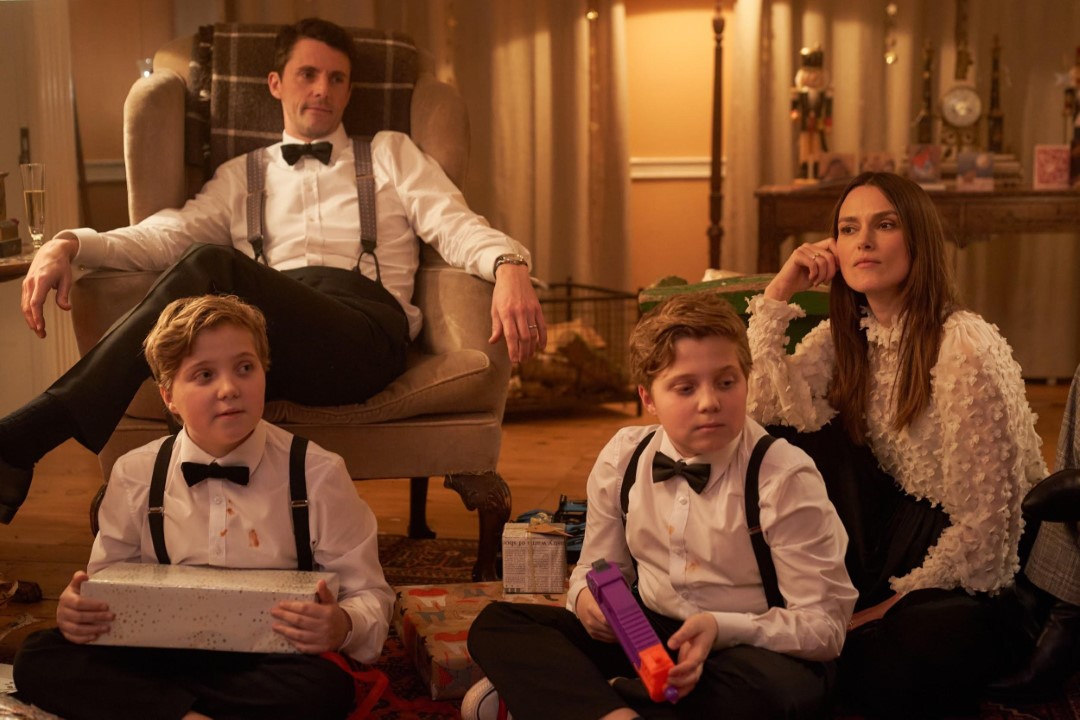
‘Silent Night’ (2021) is a rare film, a British black comedy that captures a simple truth most apocalyptic narratives are far too theatrical to admit: the end of the world would not come with operatic grandeur but with impeccable courtesy. Directed by Camille Griffin and anchored by the disarming aplomb of Keira Knightley and Annabelle Wallis, ‘Silent Night’ stages annihilation as a dinner party—civilized, well-lit, and faintly ridiculous. Its restraint is, one suspects, deliberate. Where lesser works would indulge in spectacle, this opts instead for etiquette. The guests arrive on time, exchange pleasantries, and discuss their imminent destruction, almost apologetically. Habit governs them more than courage or despair. They behave as they always have—for anything else would be vulgar. This is the film's first quiet triumph: it refuses to flatter its audience with fantasies of heroism. No one here will save the world… no one will even attempt to. They will dine, drink, and die—politely.
The Government as Host: Authority with Good Table Manners
The unseen but omnipresent host of this gathering is the State, perhaps even monarchy itself. It has provided, with admirable efficiency, a solution to the problem of continued existence: a small pill, discreetly administered, promising a painless end. No fuss, no chaos—just compliance. It would be easy and rather dull to read this as dystopian paranoia. The film is cleverer than that, refraining from casting authority as monstrous and portraying it as reasonable. The instructions are calm, measured, even compassionate. The State does not threaten; it seeks to instill confidence, or at least it appears to do so. And that is exactly why it is so effective. Here ‘Silent Night’ finds an unexpected kinship with ‘Black Mirror,’ though it lacks that show's fondness for technological hysteria. Its concern revolves around manners rather than machines—how easily obedience can be dressed as decency. To reject the drug would not merely be impractical; it would be socially awkward. One begins to wonder whether the real catastrophe is not the toxic cloud approaching Earth, but the flawless civility with which it is received. True to form, ‘Silent Night’ includes, almost casually, an act of murder—presented with the same composure that defines the film.
A Necessary Irritant: The Man Who Declines to Die
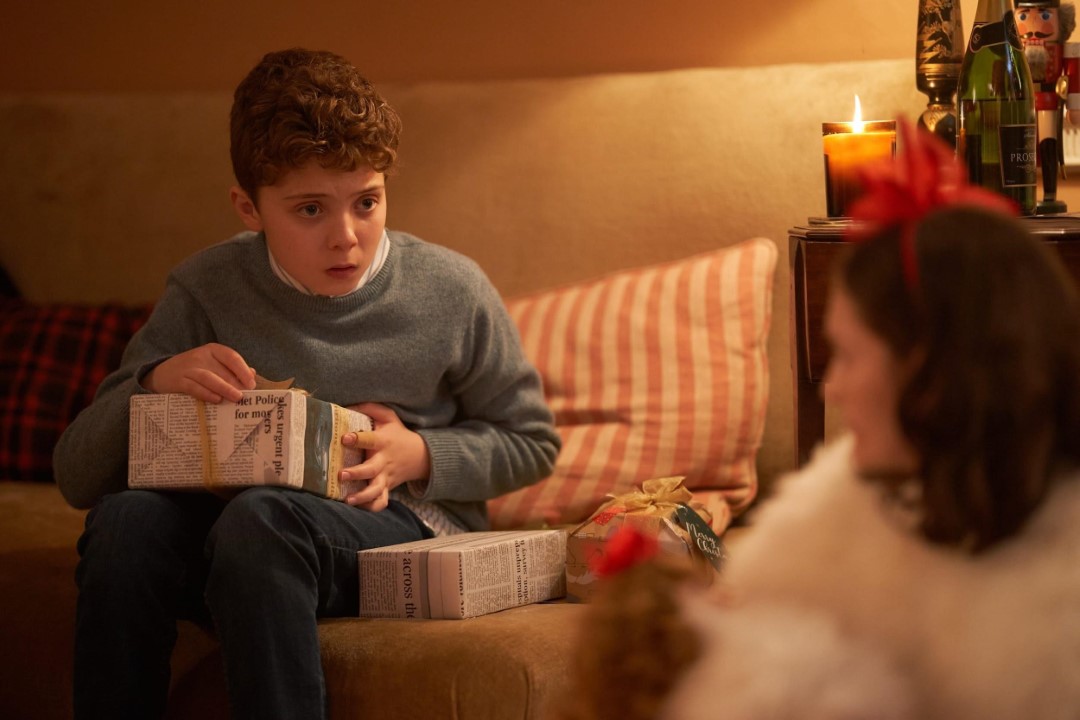
Every well-composed meeting requires a disruption, and ‘Silent Night’ introduces one in the form of the dissenter—the guest who declines the poison. He is not heroic, nor particularly eloquent. In another context he might be insufferable. Here he is indispensable. His crime is not disbelief; it is mere curiosity. He asks the sort of questions society has agreed to consider settled. How sure are we? Who has verified this? Might there be —however inconvenient— a mistake? Such questions, of course, are intolerable: they inscribe contingency within a system that depends upon its absence. No arguments are offered by the others, only discomfort is registered. Doubt in this climate is less an intellectual position than a breach of decorum. And yet one cannot help but notice that he is the only character who conducts himself as though the situation were genuinely serious; the rest have conflated their apparent equanimity with fearlessness. He alone retains the unfashionable instinct to survive.
On Venom and the Seductions of Certainty
The pill —so small yet so efficient— is the work's most elegant symbol. It is not only a means of death; it stands for a release from the burden of thought. To swallow it is to seal both life's end and the extinction of doubt. The government has spoken; the matter is closed. There is a certain appeal in this: certainty comforts—especially when responsibility is lifted. If the outcome is inevitable, then one need not trouble oneself with alternatives. One may simply obey—and call it wisdom. ‘Silent Night’ is too intelligent to argue against this directly; instead, it allows absurdity to disclose itself. The characters cling to their conviction with the anxiety of those who suspect, somewhere beneath the surface, that it may not be entirely justified. In this respect, the film shares a philosophical temperament with Lars von Trier's ‘Melancholia,’ though it is far less inclined towards solemnity or that level of sublimity. Where von Trier confronts deconstruction with Wagnerian exaltation —with the glorious Prelude to ‘Tristan’ swelling in the background— ‘Silent Night’ greets it with a raised eyebrow.

“Do Not Listen to the Government; Listen to Art”
There is hesitation in extracting slogans from a film so delicately built, but if it has a governing impulse, it might be expressed thus: do not listen to the authorities; listen… “to Art.” This is not, as the less imaginative might suppose, a call to anarchic defiance. It is something subtler—and more demanding. The government advances a narrative that is coherent and totalizing. There is nothing to add, nothing left to inquire about. It is, in short, a finished story that permits no reply. Art, both as a character and as a broader concept, resists such closure: it suggests contradiction, ambiguity, revision. To ‘listen to Art’ is to remain mentally uneasy—to assert that finality is often the least reliable guide to truth. The dissenter, in his obstinate noncompliance, adopts the bearing of an artist as opposed to a political rebel. He brings forth neither answers nor solutions; he preserves the right to interrogate. And in a world rushing towards its end, that is no small achievement.
Adorno said: “Art is the social antithesis of society, not directly deducible from it. The constitution of art's sphere corresponds to the constitution of an inward space of men as the space of their representation (...)” (Adorno, 1997, p. 8). If the State promotes a sealed, self-sufficient record —one that expects uncritical acceptance— then art, in Adorno's horizon, emerges as its negation: not a counter-narrative that replaces it, but a force that disrupts its claim to totality. The dissenter —himself named Art— embodies this aesthetic (pre)logic. His stance is not programmatic, nor does it articulate a consistent alternative system; rather, it sustains openness and ensures the possibility of questioning. In doing so he aligns with Adorno's conception of art as a liminal zone not subsumable under the structures it opposes. The movie itself echoes this slant formally: instead of resolving tensions, it leaves them suspended, pushing the audience to engage with the unpredictable. To listen to Art then in the spectrum of ‘Silent Night,’ is to turn away from any fixity and to embrace that truth may reside precisely in what remains enigmatic.

The Elegance of Refusal among Other Final Remarks
“Spending time with these characters can be a lot to ask,
but ‘Silent Night’ peers into the abyss with admirable aplomb”
—Rotten Tomatoes/Fandango Media
It would be tempting to celebrate Art as a superhero, yet the film wisely avoids such Hollywood-style sentimentality. His survival —if it is survival— is not ennobling. It is solitary, elusive, even futile. In this way it yields no guarantees that he is correct. And still we may feel that correctness is beside the point. What matters is the act of dissent itself—the insistence that the story being told is not the only one possible. In declining the “exit” pill, Art reintroduces chance into a world that has all but extinguished it. This is in its understated way the most radical gesture of ‘Silent Night,’ as it implies that the end of the world is not merely a physical event but a theoretical one—the moment when variants are no longer entertained.
‘Silent Night’ is, among other things, a remarkably well-mannered provocation: it does not scream; it insinuates. Without accusing, it observes and punctuates. This in turn exposes an unsettling scenario: that agreement, more than destruction, poses the greatest danger we face. In an age that prizes knowledge and assurance, ‘Silent Night’ makes a case —gently, with poise, and with a touch of mischief— for doubt. Not the theatrical doubt of conspiracies, but rather the disciplined skepticism that withstands resolution without further examination. One leaves the movie with a disquiet that lingers for an annoyingly long time after the credits have rolled: if the apocalypse were announced tomorrow, with all the reassurance we could desire, would we accept it? Or would we —like that most impolite of guests— decline to expire? ‘Acta est fabula…’
References
Adorno, T. W. (1970/1997). ‘Aesthetic Theory’ (R. Hullot-Kentor, Trans.). University of Minnesota Press.
Griffin, C. (Director). (2021). ‘Silent Night’ [Film]. Marv Studios; Maven Screen Media; Endeavor Content.